By Victor Menendez. Originally published on LinkedIn, 2026-09-28.
From Victor’s development notebook. This dated article describes Tri-Power research, prototypes and development goals. It is preserved as originally published, rather than as a specification for products currently available. Current product availability, compatibility and installation requirements must be confirmed for each project.
Four decades in technology, an outspoken email, and a different way to wire motorized shades.
By Victor Menendez
After more than four decades in technology, I still get excited by a good new idea. But these days, the idea that interests me most is not adding another box to the equipment closet. It is finding out how much we can take out.
In my last article, One Managed Bus, Many Intelligent Devices , I introduced the thinking behind Tri-Power. This time, I want to share the experience that brought me here, and why I believe Smart Power has an opportunity well beyond shades.
The Henry Ford email
I started in technology in the 1980s with cellular phones, then moved into home audio and what we called home automation. Some of those early keypads had light bleeding between buttons, and a button press could feel more like a question than a command. We have come a long way.
I was fortunate to spend ten years at Lutron, including the early days of its QED shading work. I learned a great deal there about precision, quality and the details customers notice every day.
That does not mean I liked every early design.
I remember shade hardware that, to my eye, looked more like a boat motor than something that belonged beside a beautifully finished window. The proportions and uneven light gaps bothered me. I was not quiet about it.
At one point, I sent an email to the executives comparing the approach to Henry Ford's famous line: "Any color you want, as long as it's black." My point was that a product should adapt to the window and the customer, rather than asking everyone to accept the same compromise.
My enthusiasm was considerably more developed than my diplomacy. A few people reading this may remember that email.
I am not claiming my email changed the product. What I remember is watching the hardware evolve and tubular motors become part of a much more refined solution. I have tremendous respect for what Lutron built.
The lesson stayed with me: insist on quality, but keep listening to the people who install and live with the product.
The man with the little suitcase
Gary Skinner was another person whose work shaped my career, long before I knew him well.
I remember him at trade shows with a little rolling bag, pulling out electronics and showing people practical ways to solve problems. Through Electronic Solutions, or ESI, Gary helped make motorized shading more useful to people like me.
I used ESI relay controls with Lutron HomeWorks systems and some creative programming to bring AC shade motors into keypad-controlled scenes. Those little devices helped me build solutions customers wanted, and they helped me make a living.
I would see Gary and think, "That is who I want to be when I grow up."
Years later, a trade-show conversation with Gary and John MacKenzie helped bring us together. Now I get to work with people I admired from a distance, developing Tri-Power's Smart Power motor line and the next stage of our Data Motor platform.
For me, that part of this story is pretty special.
Start with the wiring
Power over Ethernet, or PoE, gets a lot of attention, and it deserves a place in the conversation. It carries power and communication on the same cable and fits naturally into networked buildings.
But one cable per motor still adds up.
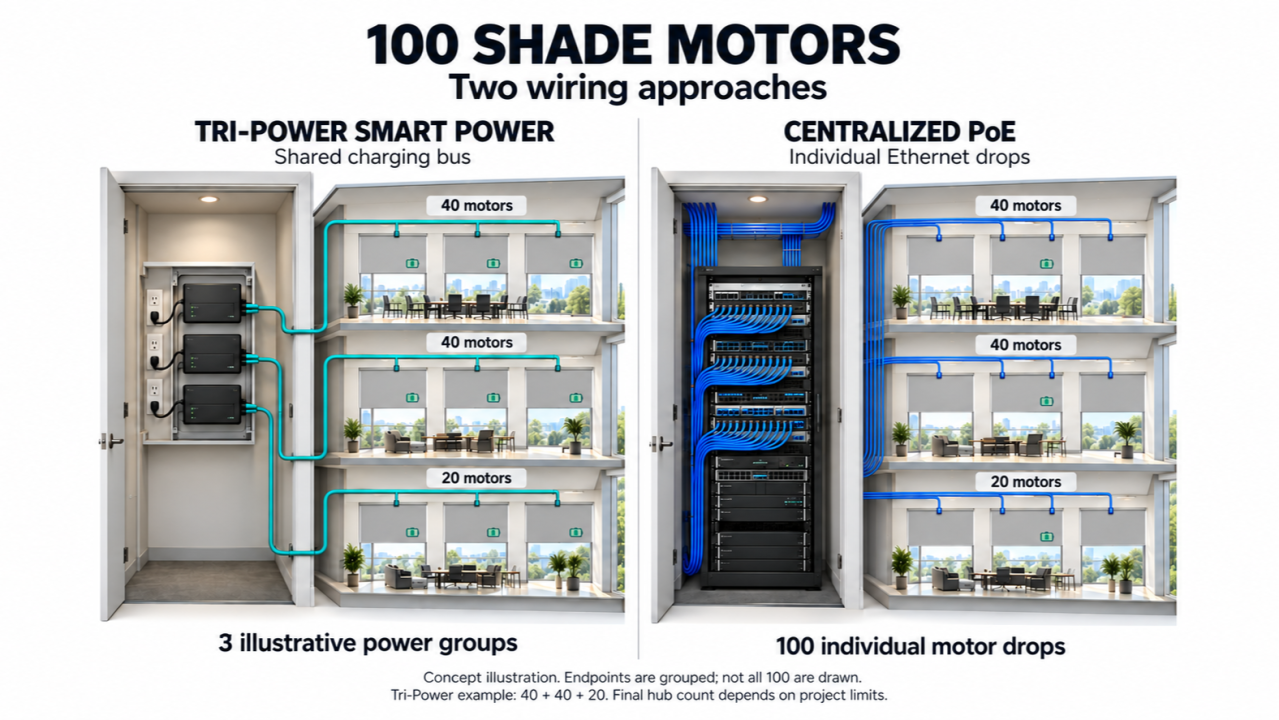
Picture 100 shade motors, each with its own Ethernet cable returning to a central closet. That is 100 cable runs to route, connect, label and test, along with the switches and connections in the rack. Anyone who has terminated hundreds of connections knows there is real work behind that tidy photograph.
Tri-Power approaches the job differently. Smart Power supports up to 40 compatible motors from one hub on shared wiring, within the system's installation limits. Nearby shades can share a route instead of each needing a separate cable all the way back to the closet.
The picture accompanying this article compares those approaches for 100 motors. It illustrates three Smart Power groups of 40, 40 and 20 against a centralized PoE installation. It is a concept comparison, not a claim that every project uses exactly three hubs or that every PoE system needs one central closet.
I am not arguing that PoE is a bad technology. I am asking whether every shade needs its own Ethernet connection when a simpler shared system can suit the job.
Power when it is needed
A shade spends most of its day standing still. Its biggest demand comes during those short periods when it moves.
Smart Power takes advantage of rechargeable energy stored at the motor and manages charging across the group. The shades can use stored energy for movement while the shared supply handles replenishment over time.
That is the difference I find exciting. We can design around how shades actually operate, not simply add more wiring and a larger supply.
Our hybrid motor approach also gives us flexibility across battery and wired installations. The Data Motor work takes the next step toward a more connected system, with wired and wireless control options and an installer app designed to make setup understandable.
An installer should be able to organize rooms, identify a shade and configure its controls without having to think like a firmware engineer.
The potential advantages include less home-run wiring, simpler installation and better management of simultaneous power demand. Electricity savings are something we intend to measure in real installations, not something a wiring picture can prove.
A small company that can respond
Tri-Power is a startup. We have the freedom to build differently, and AI is already helping us work through software, testing and technical communication.
Our ambition is to connect what happens in the field with the app, support team, engineering and manufacturing. If installers keep encountering the same problem, that information should reach the people who can fix it.
I do not want a customer waiting two years for someone to decide an annoying detail matters. We are building toward faster, more personal improvements, whether that means clearer setup, a useful dashboard or a workflow tailored to a customer's needs. Changes still need review and testing. Moving quickly should make the product better, not unpredictable.
Beyond the shade
Shades are where we are starting because we know the application. But many other small devices also need power, communication or periodic charging.
We see opportunities to explore with manufacturers of sensors, control panels, locks and other compatible devices, including applications in homes, commercial buildings, RVs and boats. Each will need its own engineering, but the question is worth asking: could Smart Power make this device easier to install and maintain?
After forty-plus years, I still like asking those questions. Now I get to do it alongside people whose work inspired me years ago.
If you have a product or device that could benefit from Smart Power, reach out to me here on LinkedIn. We are looking for device partners and investors who want to help us develop and bring this next chapter to market.
Connect with Victor Menendez on LinkedIn