By Victor Menendez. Originally published on LinkedIn, 2026-09-12.
From Victor’s development notebook. This dated article describes Tri-Power research, prototypes and development goals. It is preserved as originally published, rather than as a specification for products currently available. Current product availability, compatibility and installation requirements must be confirmed for each project.
How Tri-Power is combining established technologies into a distinct architecture for intermittent intelligent devices
Homes, offices, commercial spaces, RVs, and boats are filling up with intelligent devices. Yet the way we power many of those devices has not changed very much.
We still rely on separate plug-in transformers, individual power supplies, dedicated wire runs, replaceable batteries, and systems designed around the possibility that every device might demand peak power at the same time.
That approach works, but it can create more wire, more hardware, more service points, and less useful information about what is happening at each device.
At Tri-Power, we are asking a different question:
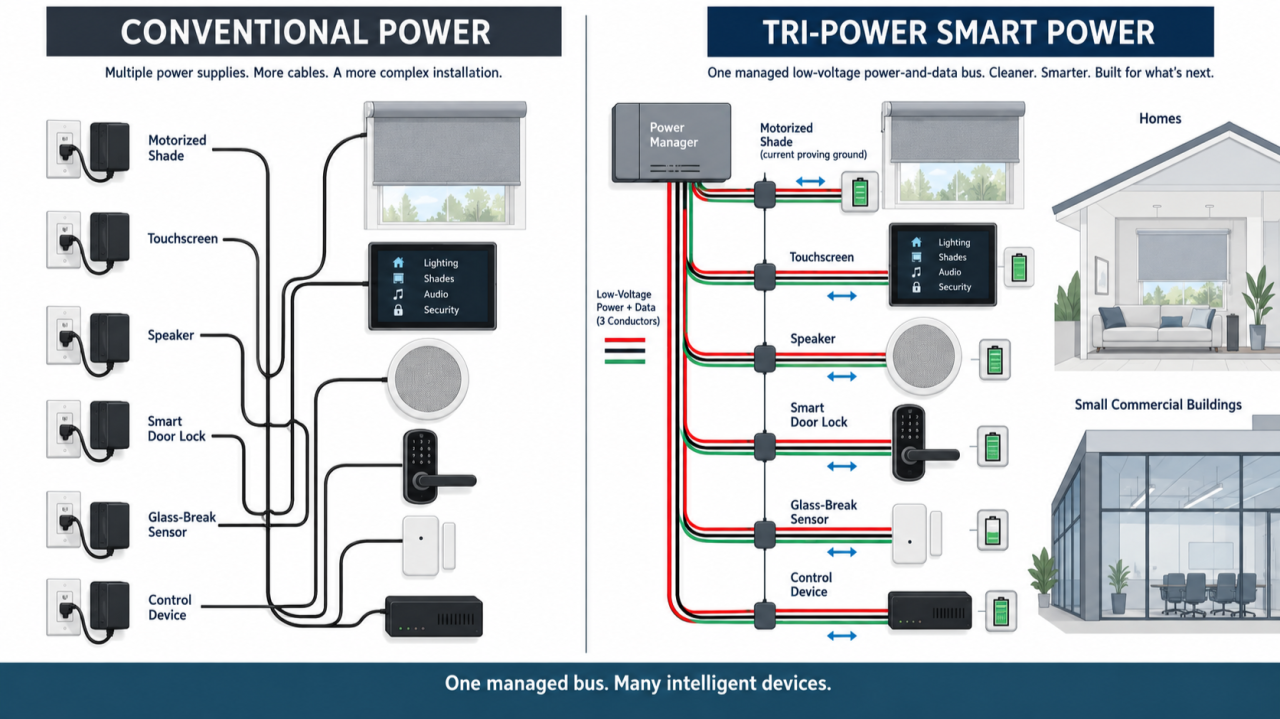
What if one managed low-voltage bus could deliver both power and data to many intelligent devices, while local energy storage at selected endpoints handled short periods of higher demand?
Built from three decades in the field
I have spent three decades working with motorized shading, lighting, controls, and complex installations, including years at Lutron and leading EX Design Group.
Tri-Power does not depend on claiming that every component is new. It takes advantage of advances in batteries, embedded controls, low-voltage communication, software, and manufacturing, then combines them into a distinct managed power-and-data architecture.
Power and data over shared cabling already exist in systems such as Power over Ethernet and KNX. Local energy storage and managed charging also exist in other applications. The differentiation we are testing is how these established technologies can work together for intermittent building devices: local storage at selected endpoints, coordinated charging, a simple shared bus, device diagnostics, and an installer-focused operating platform.
Motorized shades are the proving ground
Motorized shades are a practical place to prove this architecture. A shade motor may require meaningful power while moving, but it operates for only a short part of the day. Supplying every motor as though all motors will run continuously can lead to large power supplies and extensive wiring.
The Tri-Power Smart Power concept uses a shared three-conductor power-and-data bus. Selected devices can store energy locally, communicate their condition, and request charging when needed. A central power manager can then schedule and distribute charging instead of treating every device as an unmanaged load.
This architecture is being developed first around Tri-Power Data Motors and motorized shading. It is our current engineering proving ground, not a claim that every possible device is already supported.
The larger opportunity
The same basic problem appears throughout buildings and vehicles: many distributed devices need modest continuous power, brief bursts of higher power, communication, status reporting, or battery maintenance.
Future device categories worth investigating include:
* Touchscreens and control panels
* Speakers, intercom endpoints, and networked controls
* Smart locks and access-control devices
* Glass-break, occupancy, and environmental sensors
* Motorized shades, vents, and other intermittent motion devices
* Intelligent signs and distributed user interfaces
* Low-voltage devices in RVs, boats, and other mobile environments
These are areas for engineering partnerships and validation. Each device class has its own power profile, communication requirements, reliability needs, and certification path.
Fire alarms, emergency exit signs, and other life-safety systems are especially important examples. They are also highly regulated. We see them as possible subjects for future research with qualified manufacturers, engineers, code specialists, and certification laboratories. Tri-Power is not claiming that the current shade bus is approved for life-safety equipment.
Managing standby and peak demand
Small plug-in power supplies and adapters can consume standby power even when the connected device is doing very little. A conventional design may also be sized for a simultaneous peak that rarely occurs.
A managed bus with local energy storage creates an opportunity to reduce the number of always-on adapters and stagger when endpoints recharge. In principle, that can reduce simultaneous peak demand and make the available power work harder.
This is an engineering hypothesis that must be measured. We are not publishing a percentage savings claim today. Our next steps include instrumented prototypes, real load profiles, efficiency measurements, thermal testing, fault testing, and comparison against conventional wiring and power supplies.
More than power distribution
The data connection matters as much as the power connection.
An intelligent endpoint can report its identity, status, stored-energy condition, operating state, and service information. Installers and building operators can see devices as part of an organized system instead of troubleshooting isolated wires, batteries, and transformers.
The goal is not to replace Ethernet, Power over Ethernet, or every existing low-voltage standard. The goal is to add another practical architecture for applications where loads are intermittent, endpoints benefit from local energy storage, and coordinated power management can simplify the system.
A nimble development advantage
Tri-Power is new and nimble. Because we are not carrying a legacy software stack, we can design the product, firmware, apps, manufacturing records, and support tools as one governed system from the beginning.
AI has two separate roles in our work. At the product level, Tri-Power's published patent application includes broad AI-assisted power-management concepts involving prediction, allocation, prioritization, and system monitoring. AI is one layer of the Smart Power architecture, not the entire invention.
At the company level, we are also AI-first in how we develop software and manage information. We are building toward a shared platform where task-specific AI agents, operating through controlled permissions and tokens, can move approved information from phone-based field tools through engineering and ERP workflows.
These two roles should not be confused. Smart Power AI concerns how the product may manage distributed energy and devices. The agentic platform concerns how we manage product development, field information, manufacturing, and business operations. Additional implementations and possible inventions are being documented with patent counsel before their technical details are discussed publicly.
This approach can support applications that are customized quickly, dashboards that surface field and market trends in real time, and on-demand development tied to actual use. Configuration records and contract-manufacturing information can remain under revision control as ideas move into approved requirements.
The goal is not uncontrolled speed. Hardware, safety, testing, and certification still require discipline. The opportunity is to compress some application and workflow development cycles from years into weeks when the scope is controlled and decisions are properly recorded.
What we intend to prove
The strength of Tri-Power will come from measured results, not broad claims. Our prototype and pilot work will evaluate:
* Installed wire and power-supply requirements compared with conventional systems
* Simultaneous peak demand and standby consumption
* Installation, commissioning, and service time
* Endpoint energy-storage life and charging behavior
* Bus capacity, distance, communication reliability, and fault containment
* Manufacturing cost and repeatability
* How quickly approved software and workflow changes can reach the field
Those results will tell us where the architecture provides a meaningful advantage and which additional device categories are the right fit.
Building the next stage together
As this work moves from a shade-focused proving ground toward a broader platform, Tri-Power is beginning conversations with people and organizations that can help validate and responsibly scale it:
* Device manufacturers with intermittent or battery-supported loads
* Electrical and firmware engineers
* Building-automation and systems-integration professionals
* Power-electronics and battery-management specialists
* Cable, connector, and manufacturing partners
* Testing and certification laboratories
* Residential, commercial, RV, and marine pilot projects
* Strategic investors who understand infrastructure, automation, and long-term product development
Our motorized shade platform is the first step. The larger idea is a managed power-and-data infrastructure that can make distributed devices easier to install, monitor, maintain, and evolve.
We are especially interested in device partners with a real application to evaluate and strategic investors who recognize the value of developing a platform, not simply another standalone product.
One managed bus. Many intelligent devices.
Which device category should we evaluate next?
* * *
Tri-Power is developing a patent-pending Smart Power Distribution and Device Management System. The published application includes broad AI-assisted power-management concepts. Additional embodiments remain under review, and product capabilities, compatibility, energy performance, and regulatory approvals remain subject to engineering validation and certification.